 by
by  By Cliff Leppke
Sometimes fables become the truth. Many believed that RCA’s David Sarnoff, a wizard of the wireless, relayed shocking details at Wanamaker’s New York City department store about the Titanic disaster.
He supposedly broadcast a 72-hour marathon to become the primary and celebrated means of communication in helping to coordinate the rescue and relaying names of Titanic survivors. Authorities were supposedly informed about what the dots and dashes sent from the rescue ship Carpathia meant.
 This story is powerful. Ken Burns retold it in his 1992 documentary “Empire of the Air: The Men Who Made Radio,” based on Tom Lewis’ book, which might be called “Empire of the Error.” Historians who’ve carefully examined contemporaneous accounts from 1912 found holes in Sarnoff’s narrative.
For example, Wanamaker’s radio shack was closed on Sunday, when the Titanic sank. Also, in 1912, Sarnoff was a manager not a radio operator. Sarnoff’s airwave account, which claims President William Taft cleared the airwaves for him, moreover cannot be found in New York newspapers. It’s now believed Sarnoff’s fib was published nearly a decade after the Titanic sank: 1923 — probably aided by RCA’s PR department. Sarnoff overstated his role, perhaps relaying messages after, not during, the Titanic disaster.
Radio creation myths are not told and retold because they’re factual. Instead, we embrace them because they convey a truth about the human experience.
 Volkswagen has its own lore. Whether its contemporary reports of the wonders from Wolfsburg, or more recent automotive writers who’ve told VW’s production and model history, we find the evidence often doesn’t jibe with what we’ve believed about the German economic miracle on wheels.
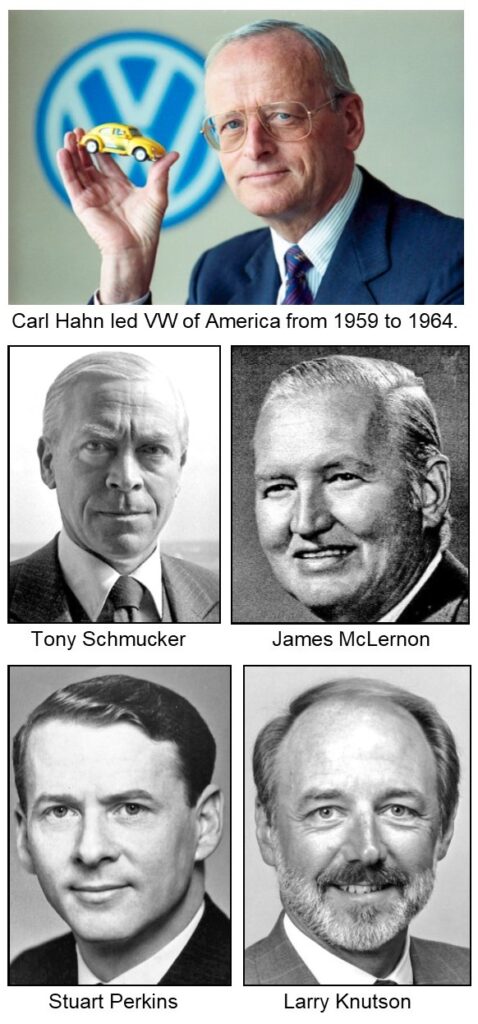
I’m going to share what I’ve learned reading Carl Hahn’s “My Years at Volkswagen,” a biography about his role as one of the firm’s brightest stars, one of the men who set VW of America on an unbelievably successful path, chose Doyle Dane Bernbach to pitch the Beetle and then later returned to VW in Germany to guide the Golf generation. He died in 2023 at age 96.
I’ve interviewed two VWoA PR professionals who either knew Hahn or worked for VW between 1967 and the early 1990s: Tom McDonald and Larry Nutson.
I’ll stick to Hahn’s timeline for this trip through VW history. Then, I’ll examine Foreign Car Guide’s coverage of that darn VW 1500 again (Jan/Feb Autoist). Between 1961 and 1966, Foreign Car Guide published at least 18 issues that discussed what it called the most talked about VW.
The Westmoreland-built Rabbit
The German-born Hahn, often called Mr. Volkswagen, worked for VW during the Beetle heyday — president of VWoA from 1959-1964, later serving on VW’s executive board, left, or more accurately, was kicked out in 1972, for a stint at Continental, yes, the tiremaker. He returned to VW in 1982 after CEO Toni Schmücker’s heart attack and is credited with boosting VW’s earnings and shifting VW’s vehicle lineup toward multiple lines, with an additional strategy to create distinctively different VW brands: Audi and VW.
You might say he was a visionary who championed the Beetle, Microbus and later the Golf. Plus, he expanded the firm’s reach into China.
Hahn says that when he succeeded Schmücker, who died in 1996 at age 75, he visited VW sites around the world. Hahn wanted to encourage personal interaction, which McDonald says impressed him. For example, years earlier, McDonald arranged a 1971 Cape Cod getaway for Hahn and VWoA CEO Stuart Perkins. The itinerary included sailboating. McDonald was a relative nobody in VW’s world, but he says Hahn made a favorable impression. McDonald recalls asking Hahn whether the Cape Cod respite was satisfactory. Hahn said it was, with one exception. He noticed McDonald rode the Type 2’s clutch too much while chauffeuring Hahn. Tom says he probably was nervous and didn’t want to stall the Bus with the boss riding shotgun.
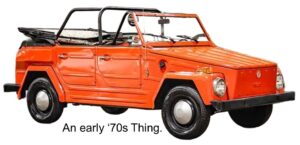
 McDonald has other stories to tell. For example, he staged a Massachusetts DMV VW Thing exhibition to prove it was a multipurpose vehicle. The first trial was an embarrassing flop at a sandy beach. The Thing needed different tires. With them, it passed the test. Now you know a bit more about the ill-fated Thing’s short life (1973-’74 in the U.S.) as the VW that could do everything, except convince Ralph Nadar and federal regulators that the Thing wasn’t a small-on safety Beetle-car clone.
Let’s continue our Hahn journey. Hahn described as capable his VWoA successor Perkins. However, Perkins, who died in 2014 at age 86, was unwilling to work under James McLernon, a former GM manager hired to get VW’s Westmoreland, Pennsylvania, plant up and running. Hahn regarded McLernon as a “typical GM manager, in the best possible sense” because he made every effort to build up the VW Group in the USA as ordered. Unfortunately, McLernon, while navigating an “unrealistic” job, foundered.
 Hahn was appalled at the resulting American-produced Rabbit. “I almost ended up in the ditch. Like its handling characteristics, the car’s interior had also been Americanized.” VW, before Hahn’s return, had given its American (GM) management team the freedom to “improve” the Rabbit in accordance with GM’s philosophy. In addition, Hahn said the quality wasn’t up to scratch, leading to “consequences.”
Hahn says the German HQ took little notice of the giant U.S. market, ignoring it almost completely. Rabbit sales had halved in two years. They peaked at 214,835 units in 1979 and by 1982 had dropped to 91,166 and kept sliding. Diesel sales, likewise, rose to 99,308 (1981) and fell to 15,686 in 1983. VW’s Westmoreland plant was operating well under capacity, making “dangerous losses.”
In addition, VW bought yet another plant in Sterling Heights, Michigan, which McDonald said had its paint booth and production lines completed. This new factory’s capacity was 1,000 units a day or a quarter-of-a-million cars per year. Hahn closed the proposed plant, disappointing the engineering team behind it.
McLernon, who died in 2019 at age 92, showed Hahn yet another site for a third VW plant. Plus, there was yet another facility or “shack” in Texas, which made air conditioning kits for dealers to install in,say, my 1974 Karmann Ghia. It had grown into an oversized facility. Hahn sold the Sterling Heights plant to Chrysler and the Texas site to Valeo — one of VW’s original equipment suppliers.
Hahn, who fired McLernon, had McDonald manage the PR fallout. At a lunch with Hahn, McDonald learned about the McLernon exit. When McDonald got bumped from VWoA in 1990, it was Hahn who offered him a job at VW in Germany. McDonald wouldn’t move his family from Michigan, however. Years later, after Hahn retired, McDonald was vacationing in Prague. At a restaurant, the picture hanging on the wall behind him was, ironically, of Hahn. He’d been honored by the Czech government for rescuing Skoda, a VW subsidiary. Hahn had made waves!
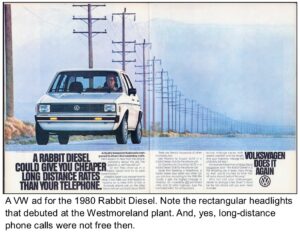 Hahn blamed suppliers/purchasing for much of the American Rabbit’s problems. McDonald agrees. VW’s 10-day sales reports and other press items in the 1980s were meant to help its suppliers. Hahn said VW was too small, an unimportant customer for the American supplier industry — something that VW knew back in 1955 when it bought an assembly plant from Studebaker and months later sold it.
Unlike Honda and Toyota’s American plants, which got their parts from Japanese suppliers that also set up shop in the USA, VW got the wrong stuff, such as those Rabbit side reflectors, which looked like they were stolen from a Schwinn dealer.
You’d think Hahn would have killed VW’s Westmoreland plant in, say, 1982. He said VW’s executive board and its supervisory board and nobody else in the management team would have agreed to that. The Westmoreland Golf II’s launch preparations had just begun. He wanted to give it a chance. Westmoreland, despite lots of cost-cutting, was a “hopeless situation.” The decision to kill the plant didn’t go smoothly. It was finally abandoned in 1988, and its production equipment was sent to China.
Bad Teutonic timing
Several actions reflected the lack of precision Teutonic timing in the USA. One was the Pickup, an American-developed model likely spun off from a German experimental Golf station wagon study. This Pickup, never marketed wearing a Rabbit badge but, nevertheless, described as one in a brochure, began volume retail sales in 1980 at 25,532 units. VW’s official sales data do not show how many of these were diesels. Nutson, the guy who coined the Golf III Cabrio’s truncated name, says the take rate for diesels among Pickup buyers was high. 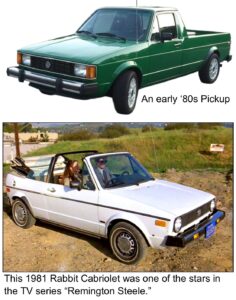
Pickup sales rose to 33,879 in 1981 and slid dramatically lower in 1983 (4,861 units). That skid, as with the Rabbit, corresponded with the diesel sales slump. It’s also possible, says McDonald, that those who wanted a novel front-drive truck bought them and that was the end of the Pickup’s moment. Ford’s Maverick truck proves Americans will buy front-drive-based pickups from Blue Oval’s stores.
Simon Glen’s “Volkswagens of the World” says VW canceled the Pickup in February 1983. A check of the United Press International’s archive found a mention of VWoA’s Jim Fuller in a piece published in April 1983 about that year’s Wolfsburg Editions, a line of domestic and imported VWs with new colors, equipment and attractive prices. Fuller said VW would stop producing the Pickup in May 1983.
You’ll find sources claiming VW either built the truck until 1984 or halted its production to facilitate the Mk2 Golf changeover. McDonald thinks this latter idea doesn’t fit known American Golf development timelines. Instead, VW canceled the Pickup because it was unprofitable, one of the measures that fits into Hahn’s story about cutting USA losses. Leftover Pickups were sold in 1984 — a whopping 392 of them. It’s likely those who’ve run VW sales numbers assume if VW sold them, it made them: wrong.
VW shipped the Pickup’s tooling, however, back to Germany, where it began manufacturing truck kits, which were assembled in Yugoslavia. VW dubbed these vehicles the Caddy. South Africa sourced the Caddy with stiffer suspensions well into the 21st century. (The Autoist’s Rich VanTreuren should be thrilled.)
Hahn takes credit for an amazing product decision. He said he chose not to develop a Mk2 Golf Cabriolet. Instead, he did something contrary to what VW’s sales forecasters wanted. He kept selling the Mk1 Cab until the early 1990s. Hahn argues that the perky Cab, as seen on TV’s “Remington Steele,” was profitable despite its modest sales.
That’s because its development costs were paid off. Again, I hear VanTreuren cheering. Moreover, Hahn said the special last-edition Mk1 GTI was a surprise hit. VW couldn’t fill the orders, which was a happy situation for the rollout of the Golf II. In fact, despite what the naysayers claim, Golf II sales reached the million-production mark faster than the car it replaced. It wasn’t an American hit, but in Europe it made VW an automotive, um, a “powerhaus.”
Golf II misses the mark
Regardless, while the Japanese competitors built eight factories in the U.S. between 1982 and 1989, VW closed nine in the same market from 1987 to 1990. The 1985 VW GTI, the hot hatch in the new Mk2 Golf line, won Motor Trend’s Car of the Year » award, as Nutson notes. Yet, for Hahn it was a disappointing time for “our U.S. organization.” He argues the Golf II simply hadn’t been tailored to the needs of American customers. Nutson thinks the Golf’s velour seat covers missed the mark. I recall the American Golf as a major improvement in interior decor. 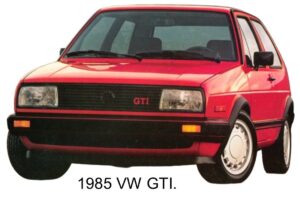
This Golf shot, according to Hahn, was painful because 20 years earlier “Beetles were snapped up as fast as we could make them.” Golf sales were a few thousand units higher than Rabbit in 1984, at 77,535, and dropped to 26,086 in 1988. I quizzed Nutson on the vapid velour story. For 1980, the Rabbit came in three velours, stripped, solid color and plush. The 1985 Golf brochure shows the car’s seats were covered in woven cloth. But the brochure for the 1985 German-made Jetta says it has velour seats. Nutson sticks to his velour narrative.
Under the leadership of VWoA’s new boss, Noel Philips and James Fuller, who later died in the Pan Am flight 103 terrorist bombing over Lockerbie, Scotland, in December 1988, Hahn thought the worst had been avoided in the U.S. For example, Jetta sales soared from just 22,972 in 1981 to 93,611 in 1986. VW didn’t manufacture the Jetta to the U.S. until the 1987 model year, after it negotiated a new agreement with the UAW (in August 1986).
This is important because you’ll find several automotive scribes who claim the Westmoreland plant built Mk2 Jettas beginning in 1985, along with the Golf. Instead, VW’s executives didn’t read the American consumer well. As McDonald describes it, the Germans thought hatchbacks were for young upwardly mobile buyers, whereas notchback sedans carriage for older less-affluent folks. That said, the first Jettas sent stateward were a cut above the 1980 Basic Rabbit … and then some. This was an unfortunate error; 1986 Golf sales were lower than the Jetta’s.
Back to basics
Neither Nutson nor McDonald recall why VW for 1973 chose the modifier Basic for the standard flat-windshield Beetle while using Super for the wrapped windshield model with deluxe trim. Both before and after 1973, VWoA used Beetle and Super Beetle. Yet, the 1980 Rabbit brochure revived the capital “B” Basic modifier for the low-priced Rabbit.
After VW shuttered its stampings plant, which it bought from AMC, Jetta body shells were briefly fetched from Mexico. The UPI reported in September 1986 that VW phased out its West Virginia stampings plant in January 1987, eliminating about 700 jobs. VW purchased the plant to supply both the Westmoreland and Sterling Heights operations. The latter never produced cars while the former’s output was far lower than its capacity.
Documentation from Carnegie Mellon University in Pittsburgh shows that VW began a Jetta framing line in Westmoreland in September 1987. This means some 1988 model-year Jettas might have been stamped in Pennsylvania. The economies, however, didn’t add up.
The Golf III was aimed at the needs of American customers, and Hahn said it wasn’t until that Golf that VW marked a turn to expansion and profits in Mexico after a shaky start. (Hahn said his successor, Ferdinand Piëch, resolved Mexican quality problems.)
Nutson says VW shuttered the Westmoreland plant and consolidated North American VW production there, certainly to take advantage of lower labor costs and possible future favorable trade arrangements. Nevertheless, the chief reason VW moved production to Mexico was to solve the Mexican plant’s profitability problem. As Hahn noted, until 1980, VW’s Mexican operations were struggling with losses, kept alive with “capital injections from the parent company.” Mexican government concessions and the balance of foreign exchange payments ultimately ensured Puebla’s future with the VW Group.
Both Nutson and McDonald aren’t certain which Jettas were manufactured in Westmoreland. They say some 1987 and 1988 Jettas were imported from Germany — possibly the GLI. Neither knows whether both two- and four-door Jettas hailed from Pennsylvania.
The Fox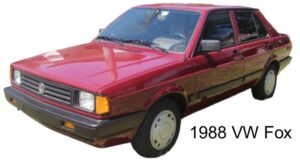
Most accounts say American tastes shifted from small cars to larger ones in the mid-1980s. This market change spelled doom for the Golf hatchback. Yet, I’d say price mattered. VWoA sold 56,932 Foxes in 1988 and only 26,086 Golfs. Because the Fox was smaller, size wasn’t the only factor in the Golf’s sales hole.
To be fair, Toyota’s Corolla deliveries decreased, too. But the hatchback Golf’s sales skid was profoundly discouraging to Hahn.
Who stymied Americans on the Type 3?
Hahn said he once quipped that “Volkswagen had become the world’s most successful company … that the British Armed Forces ever founded.” Yet even during the early-to-mid-1950s VW chief Heinrich Nordhoff was aware of risk. Despite the Beetle’s success, a future discontinuation could threaten survival. While it bettered the Ford Model T as a mass produced worldwide wonder, a successor for VW, with sales volume to match the Beetle, was necessary. Ford’s loss of market share and complete halt of all Model T production during the Model A changeover reverberated in Nordhoff’s mind.
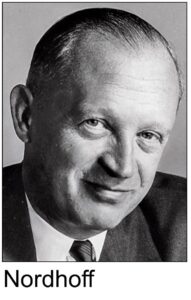 Unlike the Model T, Hahn maintained that the Beetle achieved the highest status a car can have; it became status-free. People noticed its friendly shape. Yet, Nordhoff feared Beetle demand wouldn’t soar into the millions.
Hahn said the Beetle replacement problem was daunting because VW hadn’t designed its own unique vehicle. As Hahn notes, even in the early Beetle days, when production figures were low, dealers were clamoring for a new car with “four doors and the engine in the right place!” Yet, development money was tight. Hahn maintains that for nearly two decades almost all of VW’s developments were built on the Beetle concept; “they were never very satisfying,” he said.
Hahn’s account might reframe VW history. He said the Type 3 was positioned too close above the Beetle. It was also based on Beetle technology, with all its “associated disadvantages, and for customers it represented little more than an underwhelming conventional body variant — small letter v.”
He argued it was better to rely on the Beetle and use available marketing tools to get the most out of it rather than replacing it too soon.
Hahn’s version of reality deviates from the usual story that VW didn’t import Type 3s in the USA because of a lack of capacity to produce it. Well, capacity mattered. Foreign Car Guide reported that labor shortages in Wolfsburg cut Type 3 output below VW’s plans, and throughout Europe back orders for the car piled up.
Car & Driver’s 1964 investigation into the real reason why VWoA wouldn’t sell Type 3s — corporate manipulation to prop up the Beetle — wasn’t far from the truth. Hahn said that as long as VW could continue to guarantee sufficient growth in the USA with the Beetle, “I even avoided importing the Type 3; a policy that was heavily criticized in Wolfsburg.” But this kept VW’s American organization at optimal cost and created a planned reserve market for the expected European excess production capacities. In 1971, the U.S. market provided just this valve function, enabling sales of more than half million VW vehicles and record Beetle production.
Back in 1959, when Hahn arrived in the U.S., he expanded VW’s sales organization from 300 to 1,000 dealers, even though production capacity couldn’t satisfy that.
He noticed “gray imports” of Beetles. In 1958, these accounted for almost 50% of the total VW registrations in the USA, amounting to 100,000 cars. Large workshops in the Port of Hamburg were mass-converting European Beetles to meet American specs. This evidence proved VWoA could move more cars if it got them.
When Wolfsburg presented the Type 3 sedan prototype in 1960 to several bosses, including men from VW’s subsidiaries in Canada, Asia, Australia, Africa, Brazil and Hahn (U.S), Hahn said none were impressed by it, “which resulted in us establishing a secret greeting among ourselves. It was Werner Jansen (Canadian boss) who instigated development of the Type 3 Variant (Squareback), setting in motion a vehicle type that played an important role in the VW’s product range.”
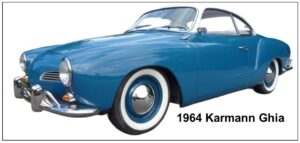 Hahn returned to Germany in 1964 and strongly disapproved a Type 3-style vehicle built on the Type 1 Karmann Ghia platform — EA97. He feared the car would ruin VW’s reputation. Plus, it was too close to the Beetle, a design in “mortal danger” that could be interpreted as an admission of the Beetle’s end — a topic of much press speculation.
He agitated against the EA97. A pilot assembly line for it was at the Wolfsburg plant; it was scheduled to appear at the 1965 motor show. Nordhoff, according to Hahn, agreed to Hahn’s request to cancel the project. To the dismay of engineers, the EA97 disappeared, and vehicles already built were scrapped.
In contrast, Hahn considered Brazil a safe place to send the EA97’s tooling. The cargo ship carrying the production equipment sank and wasn’t salvaged until a year later. With no Type 3 cars in the Brazilian market and competition weak, the EA97 made headway, especially the Variant or wagon version. He also said the EA97 led to the Brasilia car as well.
By the late ’60s, it was clear that if the American demand for the Beetle were to falter, VW needed a backup. But VW’s automotive cupboards were bare. So, VW formed a product planning committee in 1967. Multiple development partners were chosen to create proposals: VW in Wolfsburg, Auto Union (Audi) in Ingolstadt and Porsche in Stuttgart. 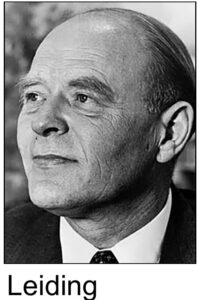
All submitted different Beetle-successor concepts. All three were developed to prototype stage. The VW team presented a compact, light sedan with a tailgate, front-wheel drive, transverse engine and ingenious twist-beam rear suspension. Sadly, two of the VW engineers behind this program died in 1973, during test vehicle driving.
The Wolfsburg team’s model suffered from the uglies. Giorgetto Giugiaro was, therefore, put in charge of the design. The Golf body Giugiaro created formed the basic elements for several generations of Golf-class vehicles.
Audi’s proposal had front drive with a longitudinally installed engine. It was lighter than existing Audi models. Porsche’s EA266, developed under Piëch, had a mid-mounted water-cooled four-cylinder in-line engine that was a subject of controversy.
VW killed the EA266
In 1971, during Rudolf Leiding’s era, VW’s committee settled on the Wolfsburg prototype. This was the Golf’s birth. VW made a complete break with air-cooling and rear engines. While VW nixed Audi design as the Beetle’s replacement, it later became the Audi 80/Fox and VW Passat/Dasher. VW’s Golf, moreover, used Audi’s EA 827 engine.
Hahn argues that the EA827 moved VW forward; an estimated 100 million were produced. These first water-cooled VW engines (not NSU’s) were designed by Franz Hauk and Ludwig Kraus.
This engine’s new-to-VW technology, right down to the gray cast iron engine block, required completely new production facilities. The investment in radiator production in collaboration with Valeo was called “unprecedented.” The new product range required a large investment by VW, its suppliers and customer service organizations. Hahn said it was a miracle that the Beetle enabled the company to reach the Golf’s “safe harbor.”
From here, Hahn discussed his quest for building an honest VW that runs and runs. Nevertheless, he wanted a two-brand (later became four) platform strategy to position the VW Group to serve multiple markets. He wanted to be sure that VW’s brands were different, not just cosmetic bits, as was the case with GM. VW, therefore, stuck to transverse front engines, while Audi developed longitudinal front-drive cars. Sometimes, however, VW muddled this plan with overlaps, especially between the Audi 80/Fox and Passat/Dasher/Quantum.
Microbus: Troubles before chicken tax
Hahn says he realized in the early 1960s that Type 2 Transporter couldn’t compete on the U.S. market against the local competition. He, therefore, hatched the idea of shifting VWoA’s focus to a new target group: the family; the suburban American housewife. Ladies. step right up, and some did! The cargo Transporter was “overstretched when it came to rugged commercial use.” In contrast, it became a “reliable family bus” or VW’s station wagon. Average profits, moreover, for the better equipped vehicle went up, Hahn said, “its marketing costs and costs associated with complaints went down.” This success came about almost overnight and it helped overcome a sales crisis for this machine in 1961. That date is several years before the so-called chicken tax supposedly killed the Transporter.
That VW 1500 again 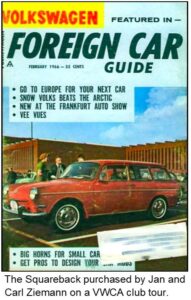
Does the news about the ID. Buzz and ID.4 put your VW enthusiasm in the dumps? Let’s return to the 1960s when Beetlemania and Type 3 fascination were hot stuff. The Type 3’s bootleg hit status promised to repeat the Beetle’s own gray market story. And indeed, when Americans could buy the Squareback, demand for it was robust. It wasn’t a flash in the foreign-car floor pan with about an eight-year sales run of nearly 600,000 units. Even Consumer Reports commented in its 1973 Fastback road test that there were reasons why VW sold nearly 100,000 Type 3 vehicles a year.
Between 1961 and 1966, Foreign Car Guide published at least 18 issues with Type 3 stories. It was shown on the guide’s covers in color at least five times. That’s astounding for a VW not officially sold in the U.S. Several times, the VWCA wormed its way into these contraband car accounts. That’s because the club’s European tours were excellent opportunities to sample and perhaps bring home a Squareback — all but one of the cover photos were Squarebacks. This led one Menasha, Wisconsin, reader to request stories on the 1500 Karmann Ghia. He bought a bootleg 1964 1500 KG and was itching to know more.
And according to Foreign Car Guide’s publisher, Joseph Hardie, who bought a 1500 S Variant during a fall 1964 VWCA tour, VW opened overseas delivery of the 1500 in January 1965, several months before the 1600cc version was ready for sale in the USA. The guide’s February 1966 color cover’s 1600 Squareback was picked up during a different VWCA tour by Jan and Carl Ziemann.
The guide’s Type 3 coverage overall provided lots of technical information and plenty of photos of VW’s second car line and its technological features. Those features represented upgrades in the VW rear-air-cooled engine philosophy, sort of predicting the updates the Bug got from fresh-air heating, bigger engines to revised rear suspensions.
Sometimes Foreign Car Guide’s Type 3 scoops had the tone of TV’s TMZ — too much chatter and some factual errors. For example, Bill Brown’s April 1964 “Small Car Scoops” sought to answer the question so many VW owners asked: When will the VW 1500 be available? He predicted spring 1965, close, but then followed that with estimated prices for the VW 1500 convertible and VW 1500 Karmann Ghia convertible. Neither model was mass produced after VW displayed them at the 1961 Frankfurt auto show.
The July 1963 issue’s cover teased readers with these words: “That 1500 Again.” John Berridge’s article inside told readers about what it was like to drive the 1500 for a “long period” in Canada. This, he claimed, was the dispatch people wanted to hear.
In the guide’s June 1961 issue, Harold Green’s piece revealed “stunning news” on the “gem of a car” the VW 1500. He pondered: Why did Wolfsburg release photographs and break the news about a VW now, so soon before the actual production began? Why is it so apparent that there are no plans to sell the VW 1500 in the U.S.?
Neither Hahn, McDonald nor Nutson could inform on why VW “leaked” so much Type 3 press info. The now long-ago constant dribble about a forbidden VW model and its development caused much confusion among VW fans then and it still does.
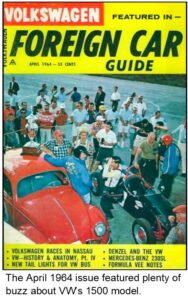 Two possible reasons: One was the automotive press stalked carmakers churning out tempting tidbits much like TV’s “Entertainment Tonight.” A second reason might be what Zenith marketing expert Jerry McCarthy, a Consumer Electronics Hall of Fame inductee, calls offensive marketing. Zenith was a master of it. This strategy used a relatively small amount of money for maximum “free” publicity. You place a no-sales salon in downtown Chicago where people would flock to watch news events on its display window TV sets. Those throngs of people and Zenith’s logo made the next day’s paper.
VW, as it turns out, spent lots of money for junkets so the American press could see the new Volkswagen in 1961. This generated scores of VW stories, pages longer than any VW advertisement. It must have worked. Foreign Car Guide’s October 1964 issue covered the ninth VWCA Convention with pictures of three members who brought their VW 1500s, one a 1500 S Variant, to Atlanta for the VW faithful to admire. They shined like a bauble from Tiffany’s.
The publication’s July 1961 edition’s editorial notes “While We’re Waiting” revealed that while VW to that moment had released a pair of silhouette-like side views of its latest creation, France’s L’Auto-Journal, the nation’s “most widely read and most controversial automotive newspaper” gave the guide permission to reproduce both shots of the VW’s mechanical details and exterior photos of pictures taken in Sweden, where VW tested the car. A cutaway rendering, while exaggerating the size of the engine’s fan, was exceptionally accurate.
Add to that, VW’s own unveiling of the car as covered in its in-house publication, which was “leaked,” and its Beetle and 1500 rotating as if floating above its Frankfurt display’s turntable (Page 6 photo) — perfect for newsreel coverage — and you’re probably looking at the kind of VW frenzy akin to the good-vibe hype that led to the New Beetle’s launch. 
By Cliff Leppke | leppke.cliff@gmail.com
ALSO IN THIS ISSUE:
- PARKED IN THE DESERT: Ten years later, 350,000 VW and Audi diesels still sit in a Mojave Desert graveyard.
- ID BUZZ . . . GONE?: The ballyhooed Bus for the 2026 model year won’t be sold here, but it’ll make a comeback.
- RINCE AND REPEAT: VW, once again, announces that it hasn’t given up on producing a small pickup.
PLUS OUR REGULAR COLUMNS AND FEATURES:
- Small Talk – VW + Audi at a glance
- Retro Autoist – From the VWCA archives
- ID Insight – Todd Allcock
- Beetle World – Steve Midlock
- Editor’s Turn – Fred Ortlip
- Local Volks – Activities of VWCA affiliates
- Classified – . . . Ads from members and others
- Parting Shot – Photo feature