 by
by Were you the Type 3 type? 
How VW failed to respond to high U.S. demand of its new 1960s line of cars
By Cliff Leppke
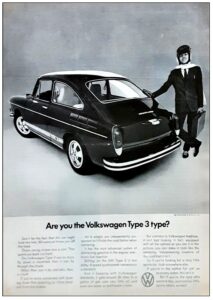
When VW of America rechristened the Fastback sedan as a Type 3 in 1971, it used one of its quirky ads to ask car buyers a pertinent question. It claimed that the Type 3 was, oddly enough, a third kind of vehicle — not a sports car and not a sedan but a racy-looking, fuel-injected, economical-to-operate VW.
The ad depicted a man wearing a helmet, scarf and driving shoes, while toting a briefcase, posing next to a Type 3. VW, however, faux confessed that the Type 3’s sports-car back was a “front.” Its racing stripes, moreover, were a con.
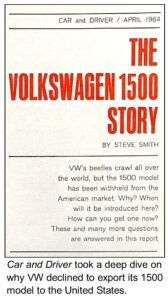
Chances are you don’t remember this moment in VW history. This is shocking: American interest in VW’s Type 3, VW’s first completely new postwar automobile, was intense. In 1964, Car and Driver claimed its mailbag was full of letters from readers who wanted this VW.
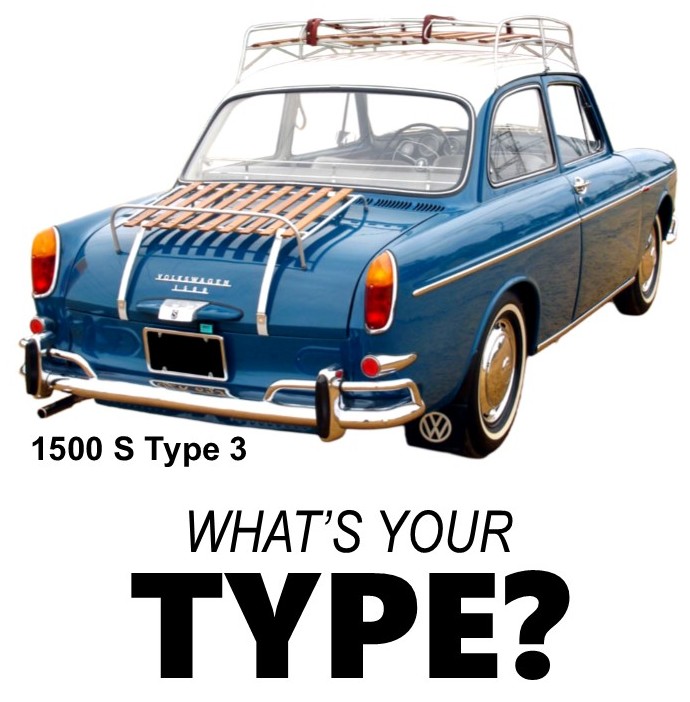 But VWoA, nearly three years after the car’s German launch, didn’t sell them. You could get one in Canada, though. The idea of VW quality in a larger economy-size made people go wild with speculation. It appeared as if predicting the U.S. arrival of its newest car line would become fodder for Las Vegas oddsmakers.
Let’s return to the early 1960s for context. Articles written about the Type 3 revealed Americans were nearly driven insane by this new Volkswagen. People were, like Patsy Cline’s jukebox hit, “Crazy,” for the Type 3. It was an addition to VW’s fleet: the Type 1 Beetle and Type 2 Transporter. The Type 3’s air-cooled rear engine displaced 1500cc, vs. the Beetle’s 1200cc mill. Therefore, VW identified its car models by engine displacements. The word Volkswagen meant the 1200cc Bug or Volkswagen 1200 Sedan. In contrast, VW used the abbreviated VW 1500 for the larger Type 3 series.
Foreign Car Guide (December 1961) claimed the VW 1500, the brand’s “latest brain-child,” had “aroused more interest than any other car in the past three years, except, the Jag XK-E.”
Car and Driver, in April 1964, likened the Type 3 to contraband. American car lovers, it claimed, were victims of a VW-imposed embargo. Thousands were getting their fixes paying as much as $3,000 (more than $31,000 today) to get a gray-market 1500 S station wagon. For that money they could have a Volvo or a Buick Special wagon with automatic and power steering. Forbes magazine described the VW as the “hot new car, which in two years has captured 18% of the German medium-sized market.”
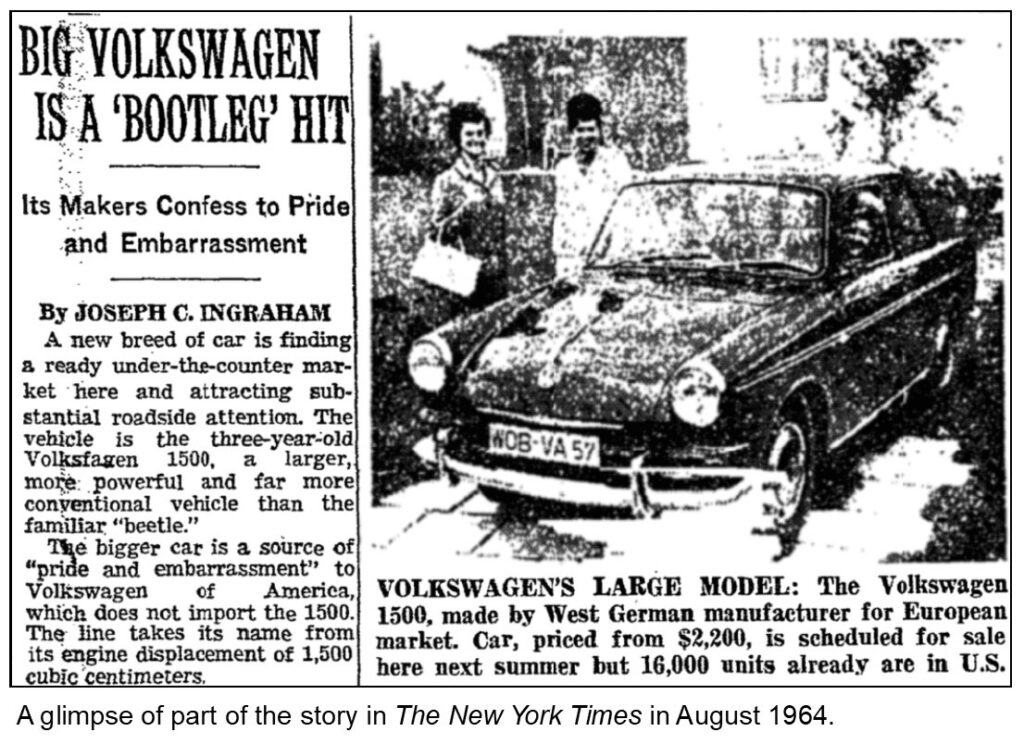
The New York Times (Aug. 16, 1964) described the bigger Volkswagen as a “bootleg hit.” Newsweek (Sept. 7, 1964) said “the VW 1500, like its snub-nosed model 1200 … seems to be inspiring Wagnerian emotion.” It claimed an estimated 16,000 “status-loaded collector’s items among American Volkswagen … fans have rolled in under the rug with buyers paying scalpers up to $1,700 above European book value” — nearly $18,000 in today’s currency.
 In sum, C&D described the frenzy over the VW 1500 like this: “If anyone believes in the Tinker Bell 1500, close your eyes and clap like mad.” Letters to Car and Driver (July 1963) implored the magazine for assistance. One Milwaukee woman asked “would you help us? … My husband and I have been impatiently awaiting the arrival of the VW-1500. …Can you give us a date regarding the importation of the 1500?”
Let’s go back to the fall of 1961 and to revisit the car’s pipedream moment. VW rolled out not one or two Type 3s but five. Motor Trend tracked the car’s arrival with May, June and October 1961 articles. The June issue revealed exclusive pictures, giving Americans their first look at the silhouette of “Europe’s most important and best-kept automotive secret.”
Besides official photos of the sedan and station wagon, MT offered pictures of the 1500’s prototypes in wintry Sweden. One shot of the car’s “luxury” interior revealed a spaghetti-like network of cables and meters, as if it were undergoing an EKG.
These cars were more than Beetles wearing fancy clothes and higher prices. As Consumer Reports concluded in October 1962, the VW 1500, although technically like the standard Volkswagen, was much quieter, rode more smoothly and had quasi-sports-tourer characteristics.
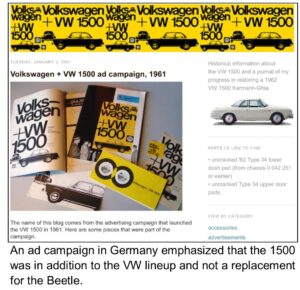
In Germany, a + VW 1500 Yellow Campaign emphasized that the car was an addition to VW’s lineup, not the Beetle’s replacement. At the 1961 Frankfurt Auto Show VW, unveiled the 1500 sedan, wagon, Karmann Ghia hardtop coupe plus two convertibles (1500 and 1500 Ghia). VW later nixed the dream-machine convertibles but commenced producing the sedan (Notchback), first followed by the Variant wagon or Squareback and then the Ghia. Four years later, VW added a 1600TL, or Fastback sedan.
The official explanation from VW was that its Wolfsburg plant, which produced the high-demand Beetle, lacked production capability to service both Euro and U.S. markets.
Yet, VW also built Type 3s in South Africa, Ireland, Australia and Brazil. And the American press, especially C&D noted, it was easy to get “new” bootleg Type 3s.
VWoA chief Stuart Perkins acknowledged as such in a New York Times story in August 1964.
“We might like to hide the fact that it exists, but it’s obviously impossible to hide the fact that there are nearly 16,000 of the cars around,” he told the Times. “We are simply trying to be fair when we attempt to play it down in the U.S. It might be called a ‘bootleg’ item, for our dealers are not equipped to service or deliver the 1500.”
 He said the popularity of the Beetle had increased demand for the 1500.
While it’s easy to document the 1500’s introduction, it’s far more difficult to explain the car’s gestation. Sources claim VW developed several experimental cars. These predicted the Type 3’s shape and mechanical features. At least two edicts are known: same wheelbase as the 1200, so VW could build either Beetle or Type 3 on the same Wolfsburg line, a wagon-friendly low-profile engine.
Two prototypes are interesting. The EA 97, which became the Brazilian Type 3, used the wide Type 1 Karmann Ghia floorpan, Beetle suspension and upright Beetle engine. The EA 160, however, had the flat, approximately 15-inch high engine, Type 3 floorpan with completely new front and rear suspensions — the major technological upgrades underneath the German Type 3.
In 1959, VW approved developing the new model. A 1300cc car was planned but scrapped in favor of a 1500cc. The first drawing for the car was made in August. The first prototype was built in November. Engine heating problems led VW to try various air-intake locations. A second prototype was tested in January 1960. Ten more were built by spring.
The flatter engine, achieved with innovative packaging, such as moving the engine fan to the crankshaft’s nose and relocating the oil cooler, meant the car could have two trunks. More importantly, the suitcase engine let VW develop a station wagon, considered a necessity to compete with GM’s popular Opel Caravan.
While the car’s technical specs sound much like the Beetle — rear engine, torsion-bar suspension and air cooling — the Type 3 was substantially different. The heater, for example, used fresh air with four heat exchangers and thermostatic controls. The rubber-mounted, ball-joint front suspension had nearly full width, solid transverse torsion bars, which crossed at angles. This geometry raised the car’s front roll center for improved handling. A sway bar was built into the front suspension housing, attaching to the upper trailing arms. The rubber mounting reduced noise and vibration.
At the back, a wider rear track, swing-axle suspension offered improved handling, which Consumer Reports thought stable in its tests. The transaxle and engine were attached to the vehicle with a rubber-mounted subframe. While the Type 3 wasn’t a quiet car, compared to the Bug, the noise transmitted from the rear mechanical bits to the interior was substantially less.
The interior was surprisingly sophisticated for a VW — an electric clock and electric fuel gauge seemed positively plush to those traditional VW drivers who motored without a fuel gauge. The padded dashboard wrapped into the door cards. The doors operated front-seat back locks and sported long armrests. The wife of Heinz Nordhoff, who led the company at the time, requested the front passenger’s grab handle.
The 1500, despite the frenzy, needed further refinement. In the looks department it was contemporary but short on sparkle, with plain unadorned side-body creases. Most considered it in good taste with lots of glass — “smart styling” argued Popular Science (September 1961); appealing but anonymous “all one-piece look,” said Car and Driver (October 1961). Plus, “no hurt feelings,” Consumer Reports (June 1966) gushed, saying it didn’t look like a VW and provided better passenger accommodations.
 The 1500’s engine’s 53hp output was adequate but hardly vivid. This VW’s engine problems were similar, if not more intense, than those found in the new-for-1961 Beetle engine. The 1500 shared the same crankcase engineering without camshaft journal insert bearings. Plus, it had the same fragile valve-rocker mounting. Remember the fuss over valve lash settings and short or long-stud valve-box studs?
For 1964, VW introduced the 1500 S. The S sported a twin-carb engine producing 66 horsepower. The exterior got all the trimmings — bright metal trim on its flanks — a chrome lip-handle at its front, more tinsel at its rear and larger chrome signal-lamp housings. Wheels wore bright trim rings.
For 1966, as VW was about to export the car to the U.S., VW developed the 1600TL (touring limousine), a flossier fastback version. Time (August 13, 1965) said this “flashier look” was meant for the car’s invasion of the U.S. market in October 1965.
VW’s annual reports told shareholders about its dogged efforts to increase Type 3 production. It added shifts and additional workdays to increase output. It constructed the Emden plant to meet U.S. demand for, say, the Beetle, allowing Wolfsburg to build more 1500s.
Type 3 milestones
During its early years, VW built three basic models: the Sedan or Notchback, the Variant station wagon, and the Karmann Ghia 1500 Coupe. These had a single carburetor, pushbutton headlight and wiper controls (discontinued in August 1963), fresh air ventilation and “flat” tail lamps.
For 1964, VW introduced the 1500 S with all the special trimmings and a twin-carburetor engine. This special engine was standard in the Karmann but optional on the Notchback or Variant.
The 1966 model year marked the introduction of the Fastback (TL) with flexible rear-side glass flip-opening windows. Its motive force was a 1600cc twin-carburetor engine, which replaced the 1500 S. U.S. Squarebacks got all of the top-range features, including the 1600 engine, front disc brakes, full-width chrome front trunk handle, wheel-rim embellishers and four-bolt wheels. Rear drums were composite-style, secured by wheel bolts. VW added blade-like front signal lamps and larger rear lamps. Heater controls moved near the parking brake lever. Squarebacks got a Z-bar rear suspension auxiliary spring, which later migrated under the 1967 Beetle.
 One Consumer Reports reader (July 1966) asked with alarm whether his VW 1500, which “thus far, I am very well satisfied,” was hazardous. He was concerned about the dangers of which Ralph Nader warned. CR responded that the models Nader was referring to were the 1200 and 1300 Volkswagens. CR found the 1600 Squareback to be a good handling vehicle with good brakes, good visibility but vulnerable steering box. We don’t know whether this reader, who did not want to endanger his teen-age boy with the 1500, let his son drive it.
For 1967, a dual-circuit braking system and 12-volt electrics were introduced.
For 1968, the U.S. Type 3 became the first mass-produced car with electronic fuel injection. This, reported Business Week (September 1967), is “one of the most significant automotive advances of recent years: a computer-controlled fuel injection system that eliminates the carburetor.”
VW’s Kurt Lotz said “this is an epoch-making development in the history of spark ignition engine.” It cut engine roughness, boosted gas mileage and reduced noxious exhaust fumes. The cylinder heads got dual ports. The gas tank was redesigned.
A fully automatic three-speed automatic transmission was optional, according to British VW brochures, but U.S. sales literature said this transmission was new for 1969. It came with a revamped rear suspension, which replaced the former swing axles with double-jointed CV-joint axles.
A safety steering column was standard on all models. Some sources say VW added a front “bull-bar” or U-shaped tube hidden behind the front bumper passed through the front apron and hit the front axle beam and deflecting crash energy. It’s easy to see this bar on the later long-nose cars.
For 1969 all German-made Type 3s received double-jointed rear axles with diagonal trailing arms. An electric rear window defroster was standard.
VW for 1970 introduced “long nose” Type 3s (5.63 inches longer) with stronger bumpers. It increased trunk capacity; the front chrome handle was deleted. The front inner-body panels were reinforced as was the vehicle’s floor. Some 1970 Fastback brochures dropped that moniker and used Type 3 instead. The Karmann Ghia was discontinued. VW improved the engine oil cooling system and revised the cylinder heads.
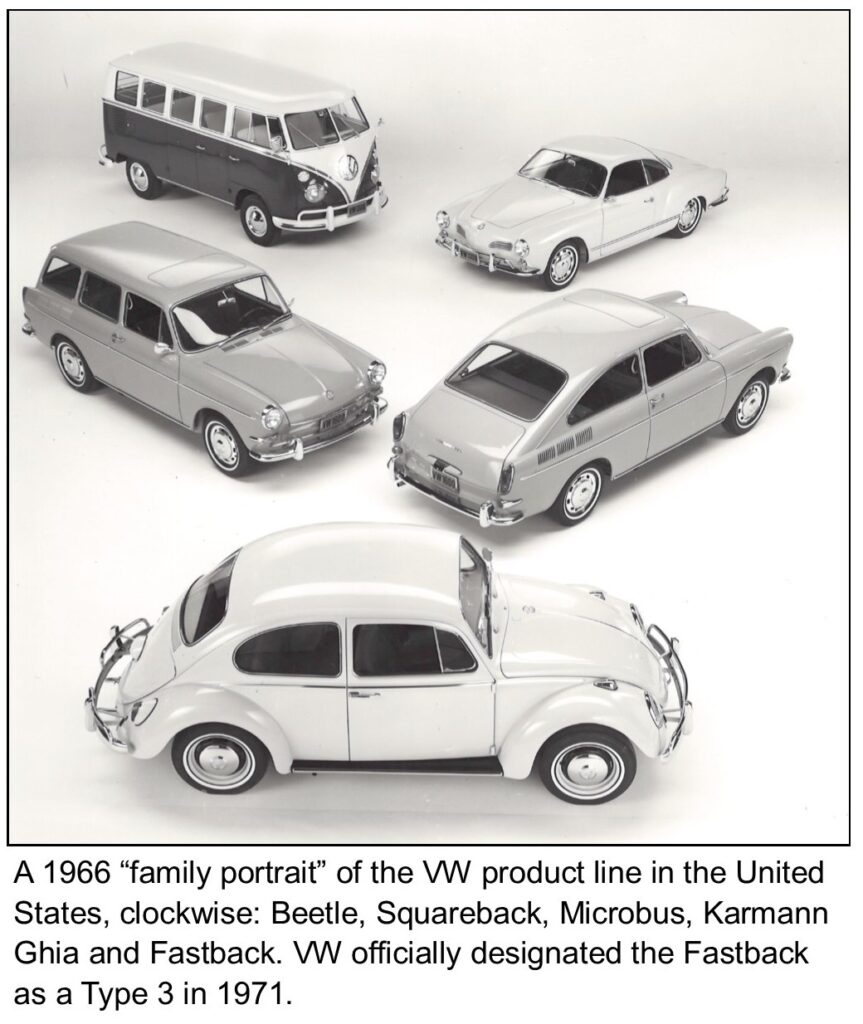 For 1971, VW added vent slots to the Fastback and Squareback’s rear pillars. These assisted a flow-thru ventilation system with fan-forced fresh air from the cowl. The Type 3’s flexing side glass was deleted. The front ashtray, for those who ignored the surgeon general, was thinner and moved upward, making room for fresh-air dashboard vents.
For 1972, VW began the model year with novel single-loop, inertial locking combination lap and shoulder belts. A four-spoke steering wheel included a collapsible element. The signal lamps housings were painted gray, gauges were now black with white numbers and a column-mounted wiper control stalk replaced the former dashboard knob. Squarebacks got a revised rear seatback. You could fold it without raising the lower seat cushion. A new engine crankcase breather system promised longer engine life.
In mid-1972, VW altered the bumpers to comply with the 1973 model-year U.S. rules. The front seats were redesigned; they slid on sturdier seat tracks. Plastic inside door handles replaced the former metal ones.
For 1973, VW offered a Basic Compact, a Type 3 without the trimmings. All models donned narrower door armrests and altered gauge faces. VW met U.S. safety rules by altering the heater/defroster controls. German production ended.
VW built about 2,587,981 German-chassis Type 3s. German production shifted to its Emden plant before its ceasing production in June 1973. Brazil produced 459,884 Type 3-like cars, pushing the grand total to more than 3 million.
VW of America sold 582,769 Squarebacks and Fastbacks. Annual sales reached a peak of 99,012 in 1970. For several years, the Fastback/Squareback was the second best-selling imported car in the States. No. 1 was the Beetle. German-chassis production climbed to 311,693 in 1966. 
Cliff Leppke | leppke.cliff@gmail.com
ALSO IN THIS ISSUE:
- TIGUAN SE: VW’s third generation SUV delivers a new look, better engine and good value.
- POLO: In recasting the names of its EV models, VW says it’s evoking the Beetle in chasing the “human element.”
- SUPERCHARGING: After months of wait, VW’s EV owners gain access to the popular Tesla power sources.
PLUS OUR REGULAR COLUMNS AND FEATURES:
- Small Talk – VW + Audi at a glance
- Retro Autoist – From the VWCA archives
- The Frontdriver – Richard Van Treuren
- ID Insight – Todd Allcock
- Beetle World – Steve Midlock
- Editor’s Turn – Fred Ortlip
- Local Volks – Activities of VWCA affiliates
- Classified – . . . Ads from members and others
- Parting Shot – Photo feature